Concrete control joints are shallow cuts that tell a slab where to crack, so the crack follows a straight line you chose instead of a random one across the middle. A common rule of thumb is to space joints about 2 to 3 times the slab thickness in feet, so a 4-inch slab gets a joint roughly every 8 to 12 feet.
Concrete shrinks as it cures. The extra mixing water leaves, and the slab gets a little smaller. The ground underneath holds the slab in place, so that shrinking builds stress, and stress ends in a crack.
You can't stop that. You can only decide where it happens. That is the whole job of a control joint, and it is a big part of how we plan a concrete driveway before any concrete is ordered.
What is a control joint in concrete?
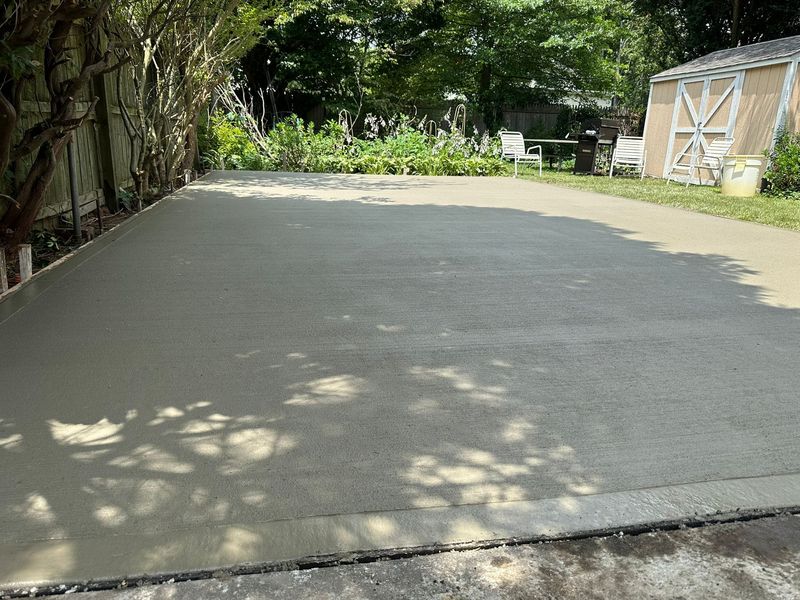
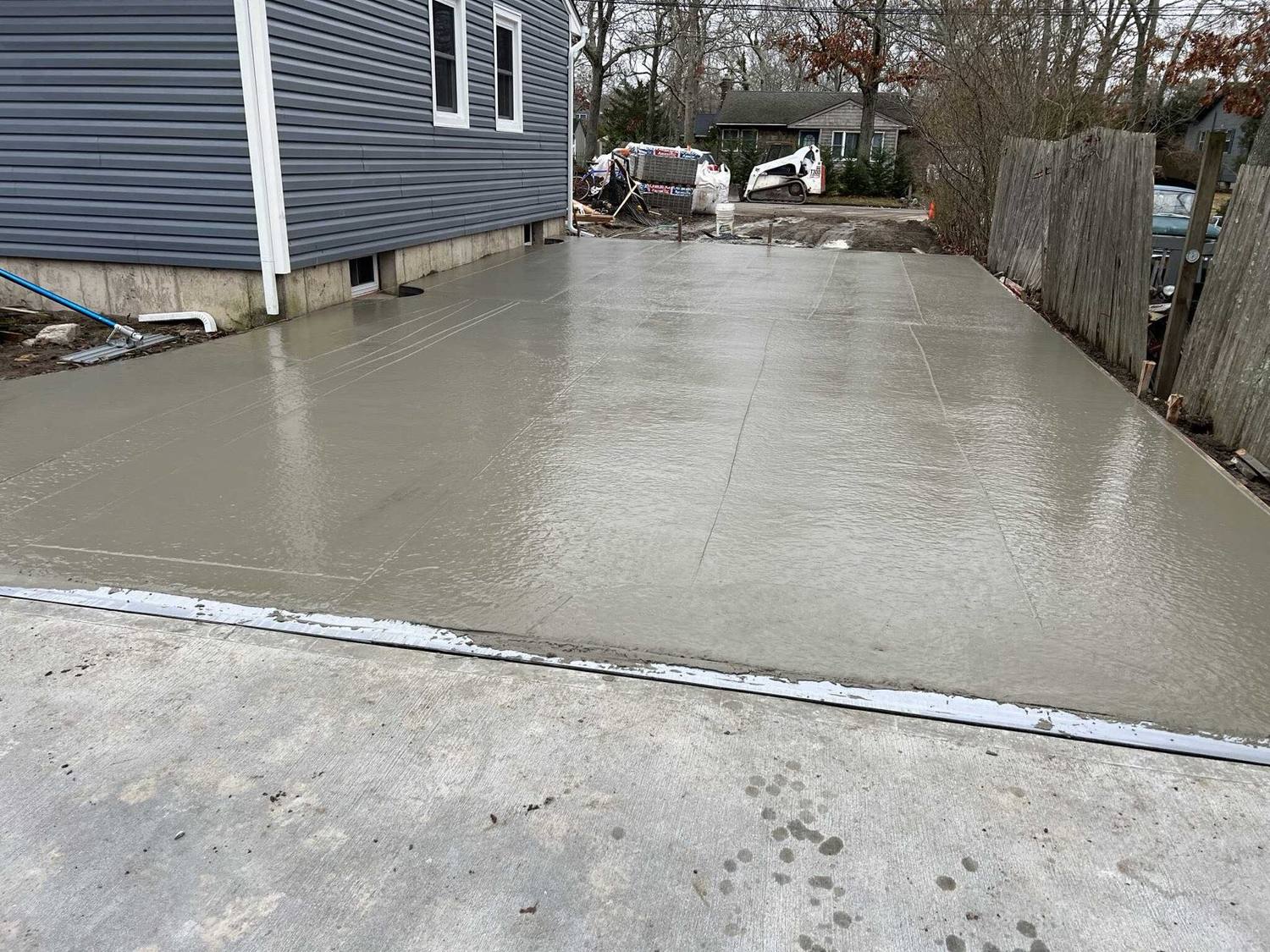
A control joint is a planned weak line. It is either tooled into the surface while the concrete is fresh or sawn in once the slab is hard enough to cut without tearing the edges.
The cut only goes part of the way down. A common guideline is about one quarter of the slab thickness. When the slab shrinks, it cracks at the bottom of that groove, where it is thinnest. The crack runs straight down and stays tucked under the line, so it looks like part of the design.
Without joints, the slab picks its own path. That is usually a jagged line across the middle of the driveway or diagonally out of a corner.
How far apart should control joints be?
The usual rule of thumb, which comes from guidance published by groups like ACI and PCA, is to space joints roughly 2 to 3 times the slab thickness, measured in feet.
- A 4-inch slab: about every 8 to 12 feet
- A 5-inch slab: about every 10 to 15 feet
- A 6-inch slab: about every 12 to 18 feet
Treat that as a starting point, not a law. Mix, reinforcement, base, weather and the shape of the pour all change the answer. If you want the exact guidance, check the ACI and PCA publications or ask your contractor how they laid out the joints on your job.
Why do the panels need to be roughly square?
Joint layout matters as much as spacing. Panels work best close to square. A panel that is twice as long as it is wide tends to crack across the narrow direction anyway, joint or no joint.
Joints should also line up with the corners of the slab and with anything that sticks out. Those are the places where cracks start on their own:
- Inside corners, like where a driveway widens at the garage
- Around a drain, a post or a utility cover
- Where the slab meets a step, a stoop or the garage door threshold
A joint that runs right to an inside corner gives the crack somewhere to go. A slab with no joint at that corner will often crack out from it within the first year.
Control joints versus isolation joints
They look similar but do different jobs.
- Control joints guide shrinkage cracks inside a slab.
- Isolation joints separate the slab from something that moves differently, like a foundation wall, a stoop or a sidewalk. They run the full depth and usually have a compressible filler in them.
If a slab is poured tight against the house with no break, the two can pull against each other. That is one reason cracks show up next to a foundation. It is also part of why we look at what is happening below grade before we think about the surface. We cover that thinking in Foundation-Up Contracting.
When does cutting the joints happen?
Timing matters. Sawing too early makes the edges ravel. Sawing too late means the slab may already have cracked on its own, in a spot you did not pick.
The window is usually the first day or so after the pour, depending on mix, temperature and wind. In cool late-fall weather the concrete sets more slowly, so the timing shifts. A cold-weather pour has its own handling needs, which we go through in Pouring Concrete in November.
Ask your contractor who is cutting the joints and when. If the answer is vague, that is worth noting.
Which cracks are normal and which are not?
A hairline crack sitting in a control joint is the system working. That is where cracks belong.
Cracks outside the joints are worth a closer look, but they are not always a disaster. Here is how we sort them:
- Hairline crack in a joint: normal. Leave it.
- Thin, tight crack between joints: common, mostly cosmetic. Watch it. If it stays tight through a winter, it is usually fine.
- Crack where one side sits higher than the other: that points to settling or a base problem, not shrinkage.
- Wide or growing crack: get someone to look at it, especially if water is getting under the slab.
We go deeper on how to tell these apart in Garage Floor Cracks in Ronkonkoma.
Tip: Take a photo of any crack with a coin or tape measure next to it. Take another after the first hard freeze. If nothing changed, that is useful information.
Do joints matter in winter on Long Island?
Yes. Water gets into any opening, freezes, expands and pries at the edges. Joints are open grooves, so they take on water like any other gap. Salt and plow blades add to it.
Some contractors seal or fill joints, and some leave them open. Either approach can be reasonable depending on the slab and how it is used. Ask what is planned for yours. If you have a newer slab, Your New Concrete Driveway's First Winter covers salt, plows and sealer.
What to ask a contractor before the pour
- What is the slab thickness, and how far apart will the joints be?
- Will the panels be roughly square, and where do the joints land at corners and obstructions?
- Are the joints tooled or sawn, and when?
- Is there an isolation joint where the slab meets the house, a stoop or a walk?
- What should I expect if a crack still shows up outside a joint?
A contractor who has thought about these will answer quickly and plainly. That tells you more than a glossy brochure does.
Planning a driveway, pad or walk around Centereach, Selden or Coram, or have a slab with cracks you want a second opinion on? Contact us and we will set up a site visit. We quote after a site visit.
Frequently asked questions
Are control joints the same as cracks?
No. A control joint is a cut made on purpose so the slab cracks along it. The crack under the joint is expected and usually hard to see.
Can I add control joints to an existing slab?
Sometimes a joint can be saw-cut into an existing slab, but it will not stop cracks that have already formed. Have someone look at the slab first, since the right fix depends on why it cracked.
How deep should a control joint be?
A common guideline is about one quarter of the slab thickness. Ask your contractor what depth they plan for your slab.
Should I seal my control joints before winter?
It depends on the slab and how it is used. Ask your contractor whether sealing or filling the joints makes sense for yours, and what product they would use.