Garage floors take abuse that no other slab in the house sees. Cars drip salty slush on them all winter, they sit on fill that nobody compacted, and in a lot of older Ronkonkoma neighborhoods the garage is a detached block building from the 1950s or 60s that was never built with a real base. So cracks are common. The question is which cracks are cosmetic, which ones mean the slab is moving, and when it makes more sense to stop patching and pour a new floor.
Three kinds of cracks, three different answers
Not every crack in a garage floor means the same thing. Get down and look at the edges.
Hairline shrinkage cracks
Concrete shrinks a little as it cures. If the slab was poured without enough control joints, or the joints were cut too late, that shrinkage shows up as thin cracks that wander across the floor. Both sides sit at the same height and you cannot catch a fingernail in them.
These are normal in a slab that is otherwise flat and solid. Seal them so salt and water cannot get in, and move on.
Wide or offset settlement cracks
When one side of a crack sits higher than the other, or the crack has opened wide enough to see down into, the slab is moving. The base under it has settled, washed out or was never compacted, and the concrete broke under the weight of the car. A slab that rocks or sounds hollow when you tap it with a hammer is telling you the same thing. This is the same kind of problem we see in a basement slab with settlement cracks, and the fix depends on how much of the slab is still in large sound pieces.
Heaving at the door
The opposite problem shows up at the garage door. The front edge of the slab lifts, the door no longer seals and sometimes the bottom panel binds. On Long Island that is usually frost. Water gets under the outer edge of the slab, freezes, and pushes the concrete up. A tree root running under the apron does the same thing in slow motion.
The slab should pitch toward the door
A garage floor is supposed to slope slightly toward the overhead door so melting snow and ice from the cars run out instead of pooling. A lot of older slabs were poured flat, or have settled so the low spot is now in the middle or at the back wall.
Standing water on a garage floor is not just a puddle. It refreezes into a sheet of ice near the door, it keeps salt sitting on the surface, and if it finds the back wall it works at the footing and can migrate toward a finished basement or the sill. If the pitch is wrong, grinding can sometimes fix a small high spot, but a slab that drains backward usually needs to be replaced to be fixed for good.
Road salt and spalling
Every Ronkonkoma driver tracks salt and brine into the garage from late November through March. It drips off the car, sits in the same spots every night, soaks into the surface and then freezes. Over a few winters the top layer of concrete breaks apart. You see pits, flaking and exposed stone, usually in two tire-width strips and near the door.
Spalling that is shallow and local can be ground down and resurfaced with a bonded overlay. Spalling that is deep, widespread or combined with cracking is a sign the surface was weak from the start, often from too much water in the mix or finishing while bleed water was still on top. At that point an overlay is a short-term fix.
The apron joint and control joints
Where the garage slab meets the driveway apron there should be an expansion joint, a soft strip that lets the two slabs move independently. When that joint is missing, crumbled or packed with debris, the apron and floor push against each other with every freeze and the edge breaks. We see a lot of door-edge failures that started as a bad apron joint.
Inside the garage, control joints are the straight grooves that divide the floor into panels. Their job is to give shrinkage cracks a place to happen where they do not show. A floor with no joints, or joints spaced too far apart, will crack wherever it wants to. A new pour gets joints laid out to the slab size and the column or post locations.
Why old detached garages settle
Detached garages in Ronkonkoma and across the Town of Brookhaven were often built fast and cheap. The floor went in over whatever fill was on hand, sometimes with no stone base and no vapor barrier. Over decades that fill compacts unevenly, the oak or maple next door sends roots under it, and the slab sinks in one corner and lifts in another.
Repair options that hold up
If the slab is mostly sound and flat, repair is reasonable.
Crack injection
Epoxy or polyurea injected into a crack bonds the two sides back together and seals out water. It works on cracks that are not moving.
Routing and sealing
For cracks that will keep moving a little with the seasons, we widen the crack with a saw, clean it and fill it with a flexible sealant. It stays watertight while allowing movement.
A high lip at a crack or a joint, the kind you trip over, can be ground flush. It fixes the trip hazard, not the cause.
Slab lifting
Where a section has dropped but is still in one piece, foam or grout pumped underneath can raise it and fill the void. It is fast and avoids demolition, but it depends on a slab that is still structurally whole.
Partial cut and pour
When one area is broken up or badly spalled and the rest of the floor is fine, we saw-cut the bad section out, rebuild the base and pour a new panel tied into the old slab with dowels. This is common at the door, where damage concentrates.
When replacement makes more sense
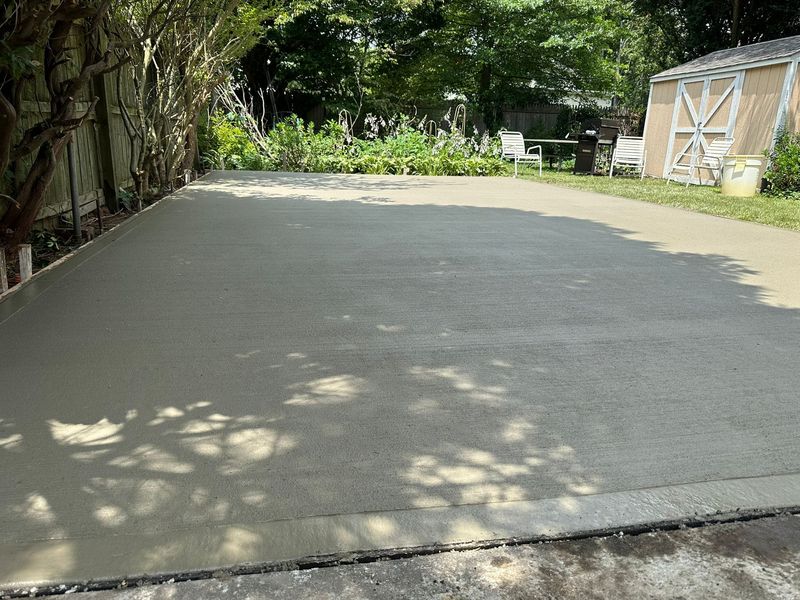
If the slab is cracked into many pieces, pitches toward the back wall, has deep spalling across most of the floor, or has settled so far that lifting would leave you with a patchwork, a new floor is the honest answer.
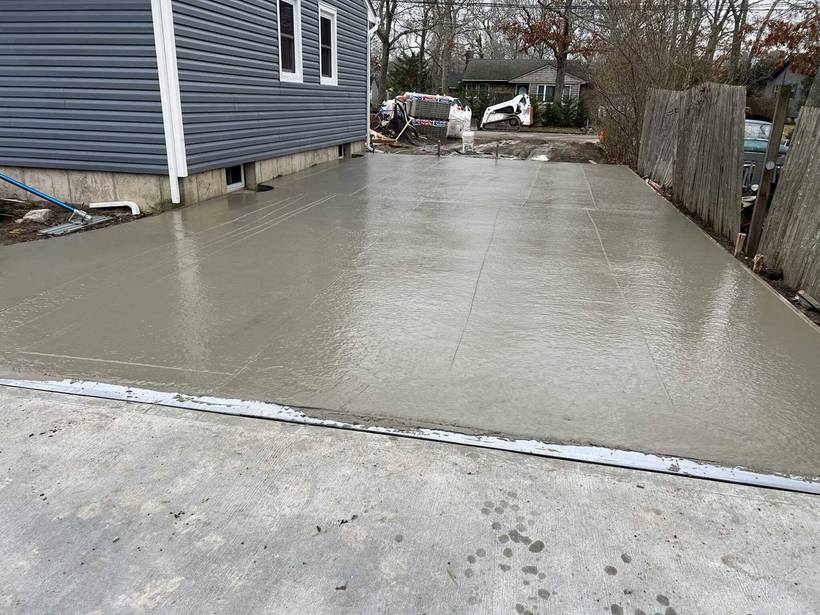
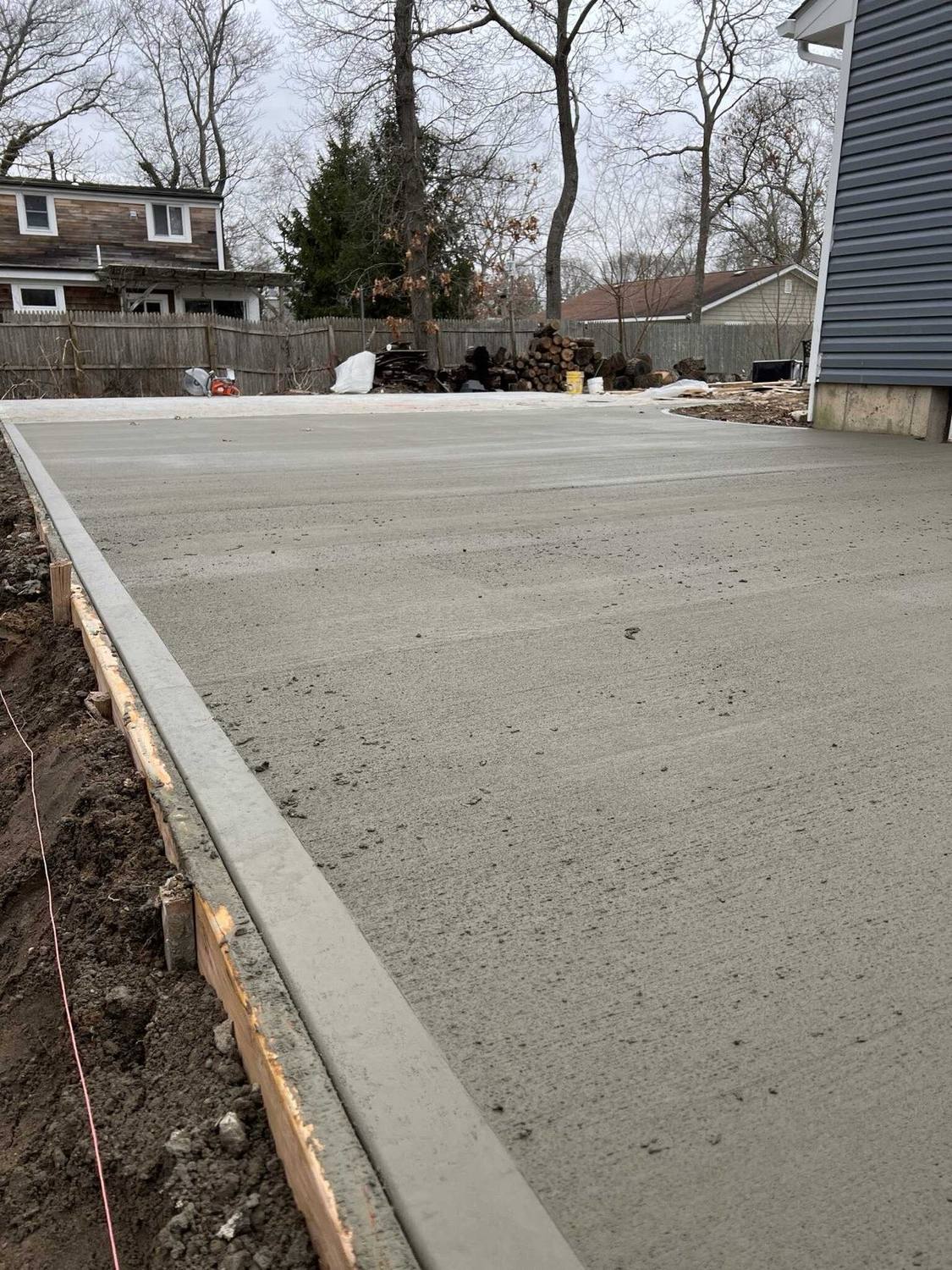
Replacement means breaking out the old concrete, digging down to a stable subgrade, placing and compacting a stone base, laying a vapor barrier, setting reinforcement, and pouring a slab that pitches toward the door with control joints cut at the right spacing and a proper expansion joint at the apron. The surface gets a durable finish and a sealer once cured.
Plan to keep cars off it for at least a week, and longer in cold weather. Concrete gains strength over about a month, and a vehicle sitting on a young slab is the fastest way to crack a new floor. If you are pouring late in the year, read our notes on cold-weather pours in Suffolk.
When to look at the footing too
If the block walls of a detached garage show step cracks, lean, or sit on a slab that has sunk, the floor is not the only thing that moved. The same goes for an attached garage where the back wall of the slab meets the house foundation and the cracking continues into the basement. In those cases we look at the whole picture, which is why JDG handles basements and foundations alongside concrete slabs and driveways. Fixing the floor on top of a failing footing is wasted money.
If a garage conversion or ADU is on your mind
A lot of homeowners start asking about the garage floor because they are thinking about turning the space into a room, a home office or an accessory apartment. A settled or badly cracked slab is a reason to replace it first, before framing and flooring hide it forever. Floor height, moisture protection and what the walls bear on all come up in that conversation, and the Town of Brookhaven is the source of truth on what is permitted. Sort out the slab, then sort out the plans.
Not sure what your garage floor is telling you?
JDG Concrete & Construction is based in Centereach, a short drive from Ronkonkoma, and we hold Suffolk County Home Improvement License #HI-68303. We will look at the cracks, check the pitch and the apron joint, and tell you plainly whether sealing, lifting, a partial repour or a new slab is the right move. Call or text (631) 672-1618 or request a quote.
Frequently asked questions
Are hairline cracks in a garage floor a problem?
Usually not. Thin cracks that run in a straight or gently wandering line, with both sides at the same height, are typically shrinkage cracks from the original pour. They are worth sealing so water and road salt stay out, but they rarely mean the slab is failing. Watch them over a season and call someone if they widen or one side drops.
Why does the concrete near my garage door flake and pit?
That is spalling, and the usual cause is salty slush dripping off parked cars and refreezing in the surface. The top layer of concrete breaks apart and leaves pits and exposed stone. Light spalling can be ground and resurfaced. Deep spalling across a large area usually points toward replacing that section or the slab.
Can a sunken garage slab be lifted instead of replaced?
Often, yes. Slab lifting pumps material under the slab to raise it back toward level and fill the void beneath. It works best when the concrete is still in large sound pieces and the problem is a settled base, not a broken slab. If the slab is cracked into many small pieces or badly spalled, lifting only moves the problem.
Should I replace the garage slab before converting the garage?
If the slab is settled, heaved or badly cracked, it is much easier to replace it before framing, insulation and flooring go on top. A conversion or ADU also raises questions about the footing, moisture and the floor height at the door. The Town of Brookhaven sets the rules for that kind of change, so start there before you pour.