Concrete countertops come up in a lot of kitchen conversations around Centereach and the Middle Country area. People have seen them in restaurants and on remodeling shows, they like that no two look alike, and they assume that a concrete company must be the natural fit to make them.
We do install concrete tops as part of a kitchen remodel, and we like them in the right kitchen. But concrete is a material with habits, and a countertop is the one place in the house where you will touch it, stain it and set hot pans on it every day. This post lays out the honest picture: how heavy they are, what your cabinets have to do, why they crack and how to keep that from mattering, and what sealing really involves.
What a concrete countertop actually is
A concrete countertop is a thin reinforced slab, usually cast upside down in a mold so the finished face is dead flat, then ground, polished to the texture you want, and sealed. The mix is not the same as sidewalk concrete. It uses finer aggregate, often fibers and admixtures, and sometimes glass fiber reinforcement in a thinner shell, which is known as GFRC. Color comes from integral pigment, from stains applied after casting, or from exposing the aggregate during grinding.
The surface can be smooth and almost stone-like or left with some texture and small surface voids, which many people like. The edge profile, thickness, integral sink and drainboard are all decisions made at the mold stage. Once it is cast, you live with them.
Weight and what the cabinets need
A concrete top at a common thickness weighs roughly what a granite top of similar thickness weighs. That is heavy, but kitchens carry granite all the time. The questions are whether your particular cabinets are up to it and how the top is supported where it leaves the cabinets.
The cabinets
Good plywood-box cabinets, screwed to the wall studs and shimmed level on a solid subfloor, handle the load. Thin particleboard stock cabinets with weak toe kicks and no back panel are the concern, and so are older cabinets that have been wet under the sink for years. During a remodel we check every base cabinet for a level top, solid sides and a floor that does not deflect when you stand on it.
Where the run is long, we often add a plywood subtop across the cabinets so the slab bears continuously rather than on cabinet edges alone. The fabricator will tell you whether their top requires it.
Overhangs and islands
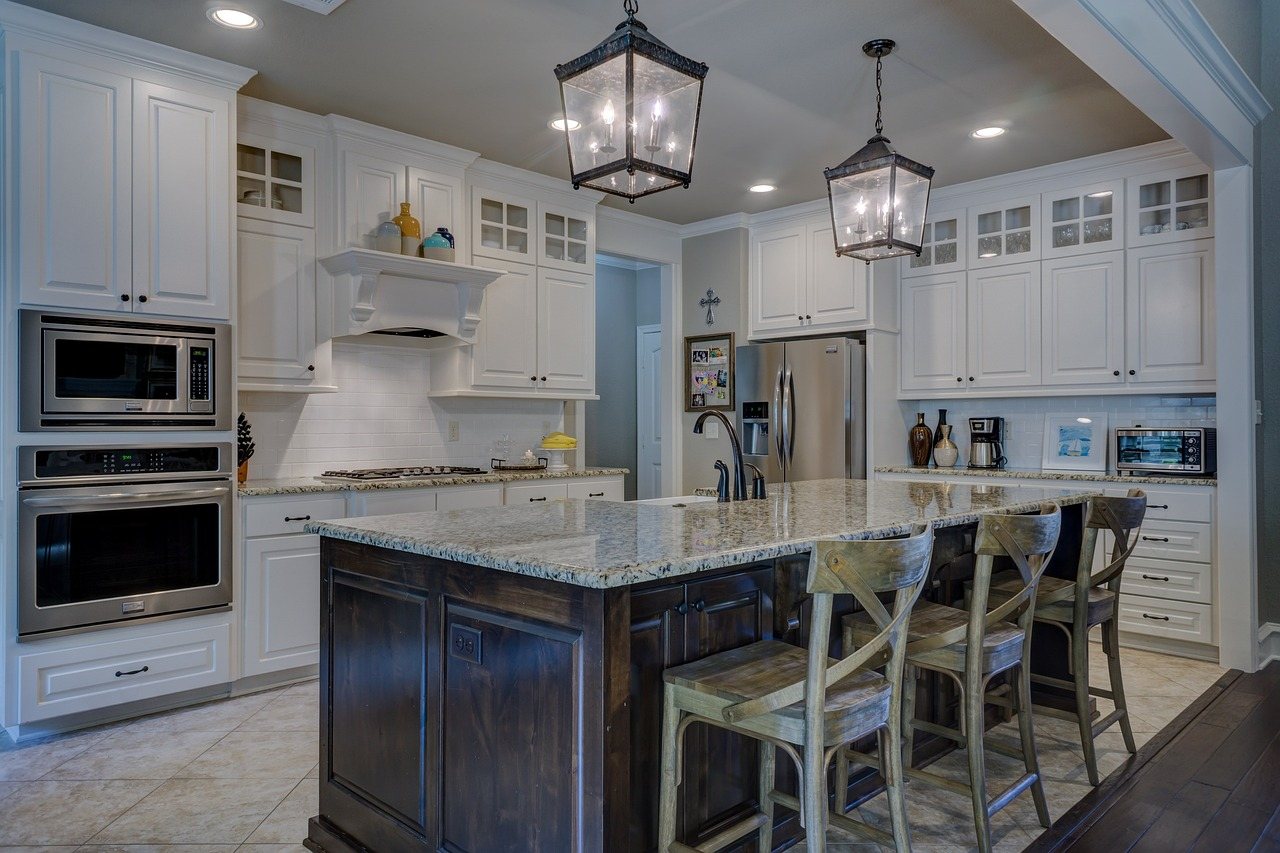
An island with a seating overhang is where weight actually bites. A cantilevered concrete slab puts a lot of load on the last cabinet and wants to tip. Steel brackets or a hidden steel frame under the overhang, anchored to the cabinet structure, are standard practice. The fabricator should tell you the maximum unsupported overhang for their slab, and the brackets have to be in place before the top arrives, not added later.
The floor under it all
On older slab ranch houses in Centereach and Selden the kitchen floor is concrete and this is not an issue. In homes with a framed floor over a basement or crawl space, a heavy island in the middle of a span can be worth a look from the framing side. Usually it is fine. Occasionally a sistered joist or a post below makes everyone sleep better.
Cracking: what is normal and what is not
Concrete cracks. That is true of a driveway and it is true of a countertop. The goal with a countertop is not to prevent every crack but to keep them hairline, tight and stable.
Fabricators do this with reinforcement in the slab, careful control of the water content, and a slow, even cure. Precast tops cured in a shop have a real advantage here because the shop controls temperature and humidity in a way a job site cannot.
Hairline cracks that appear in the first weeks or months are generally cosmetic. They are often more visible on light-colored tops and in certain light. Many homeowners who chose concrete consider them part of the look. If that will bother you, concrete may not be your material, and it is better to admit that before the pour than after.
A crack that is wide enough to catch a fingernail, that grows, or that opens at a seam or a sink corner is not normal. The usual causes are a top that is not fully supported, cabinets that moved after installation, or a top that was stressed getting it into the house. Sink cutouts and the narrow strips of concrete in front of and behind a sink are the most crack-prone zones, and good fabricators add reinforcement there and keep those strips as wide as the layout allows.
If a top does develop a problem crack, it can often be filled and refinished. It is not a tear-out situation in most cases. Ask the fabricator what their process is before you sign.
Sealing: the part nobody wants to hear
Bare concrete is porous. It will absorb oil, wine and coffee, and anything acidic will etch it. Lemon juice, vinegar, tomato sauce and some cleaners leave dull marks on an unsealed surface within minutes. The sealer is the only thing standing between your countertop and your dinner.
There are two broad families of sealers:
- Penetrating sealers and waxes soak into the surface and leave the concrete looking and feeling natural. They offer limited protection against acids and need regular reapplication, often several times a year in a working kitchen. They are easy to touch up.
- Topical coatings, including some urethanes and epoxies and newer hybrid products, form a film on the surface. They resist stains and acids much better and go longer between recoats. They change the feel and sheen of the surface, they can scratch, and when they do wear through, recoating is more involved than wiping on wax.
Which you get is a decision to make with the fabricator based on how you cook. A household that wipes up spills immediately and likes the raw look can live with a penetrating sealer. A busy family kitchen with kids and red sauce is usually happier with a tough topical coating.
Either way, the sealer has a maintenance schedule and you need to follow it. Ask for the product name and the manufacturer's care sheet and keep them in a drawer. Set a reminder. The countertops that look bad after five years are almost always the ones nobody resealed.
Heat is the other daily hazard. Concrete itself handles heat well, but most sealers do not. A hot pan set directly on a sealed top can mark the sealer. Trivets are not optional.
Where concrete makes sense
Concrete is a good fit when:
- You want a specific color, shape, integral sink or drainboard that stone cannot give you.
- You like a surface that shows its material and its age.
- The kitchen is already getting new, solid cabinets or you are confident in the existing ones.
- You are willing to seal on a schedule.
It is a weaker fit when:
- You want a surface that never changes.
- The kitchen gets heavy use and little attention.
- Budget is tight, because a custom precast top is a skilled fabrication, not a commodity.
- The cabinets are marginal and you are not replacing them.
Quartz and granite are mature products with predictable behavior, and in many Centereach kitchens they are the right call. We are a concrete company and we will still tell you that.
How it fits into the remodel sequence
A concrete top is templated after the cabinets are installed, level and fastened, exactly like stone. Precast tops then need time in the shop to cure and finish, so the schedule has a gap between cabinet install and countertop install. The sink, faucet and cooktop must be on site at template time so the cutouts are right. Plumbing and electrical trim happen after the top goes in.
If you are also touching the bathroom, some of the same thinking about slabs and moisture applies. See our post on curbless showers on a concrete slab. And if the kitchen remodel is one piece of a bigger project, read why a foundation-up general contractor matters for how we sequence the trades.
Thinking about concrete tops for a kitchen in Centereach, Selden, Lake Grove or the surrounding hamlets? Call or text JDG Concrete & Construction at (631) 672-1618 or request a quote. We will look at your cabinets, talk through sealer options honestly, and tell you whether concrete is the right surface for the way you cook.
Frequently asked questions
Are concrete countertops too heavy for standard kitchen cabinets?
Usually not, but it depends on the slab thickness and the cabinets. A standard-thickness concrete top weighs in the same general range as natural stone. Well-built cabinets that are level, fastened to the wall and sitting on a solid floor carry it fine. Long overhangs, islands on legs and flimsy stock boxes need added support.
Will my concrete countertop crack?
Hairline cracks are common and are generally considered normal for concrete. Reinforcement and control of the curing process keep them small and tight. A crack that opens wide, moves or lets water through is a different problem and usually points to a support or installation issue.
How often do concrete countertops need to be resealed?
It depends on the sealer. Penetrating sealers and waxes need more frequent attention, while some topical coatings go longer between recoats. Follow the sealer manufacturer's schedule, and expect to do something every year or two in a busy kitchen. Lemon juice, vinegar and wine will mark an unsealed or worn surface.
Should the countertop be poured in the kitchen or in a shop?
Most residential tops are precast in a shop, cured, ground, sealed and then installed, which keeps dust and moisture out of your house. Cast-in-place makes sense for very large or oddly shaped tops that cannot be moved in pieces. Both can look good. Ask the fabricator which they recommend for your layout.