Ask three contractors in Farmingville whether you should go with stamped concrete or pavers for your backyard patio and you will probably get three confident answers, usually matching whichever product each one sells the most of. We build both, so this post is the conversation we have in the yard before anyone picks a sample. It covers how each surface is built, how it behaves through a Long Island winter, what it takes to keep it looking right, what happens when something needs repair, and how to decide which one fits your lot.
How each patio is built
Both start the same way. Sod and topsoil come out, the subgrade gets compacted, and a layer of crushed stone goes in and gets compacted in lifts. The base is where most patio problems begin, and it looks the same whether concrete or pavers go on top.
Stamped concrete
Stamped concrete is a poured slab, usually with reinforcement, placed on the compacted base and pitched away from the house. While the concrete is still workable, color is added, a release agent goes down, and large textured mats are pressed into the surface to leave a pattern that reads as stone, slate, brick or wood plank. Control joints are cut or tooled so the slab has planned places to crack. After it cures, the surface is cleaned and sealed.
The result is one continuous surface. There are no joints to fill with sand and no edges to restrain, just the control joints and the sealer.
Pavers
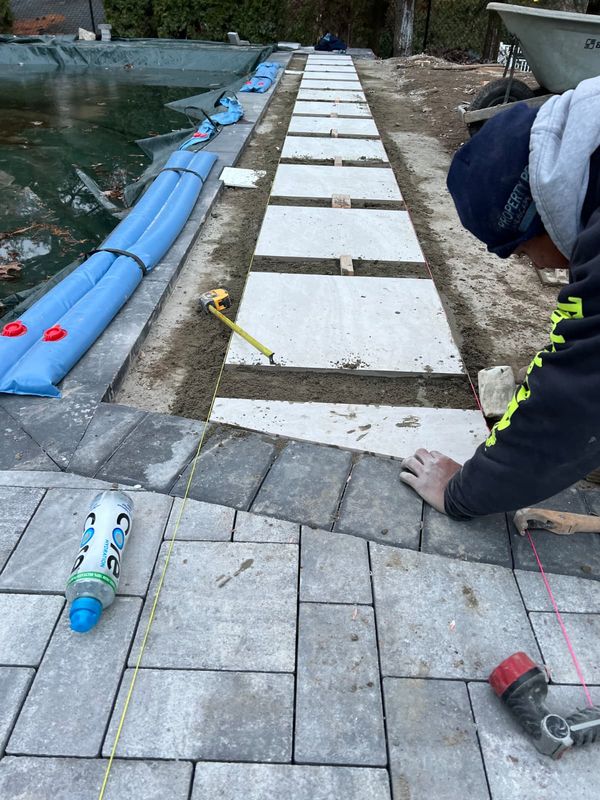
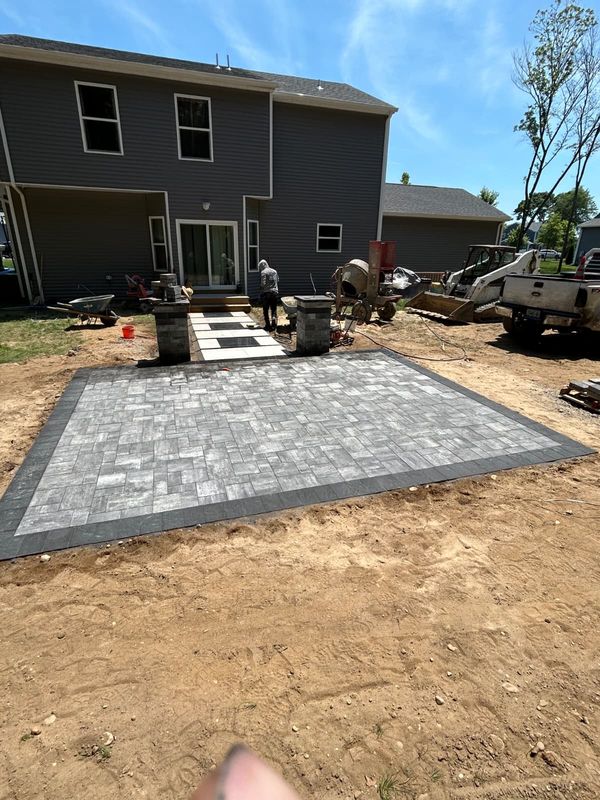
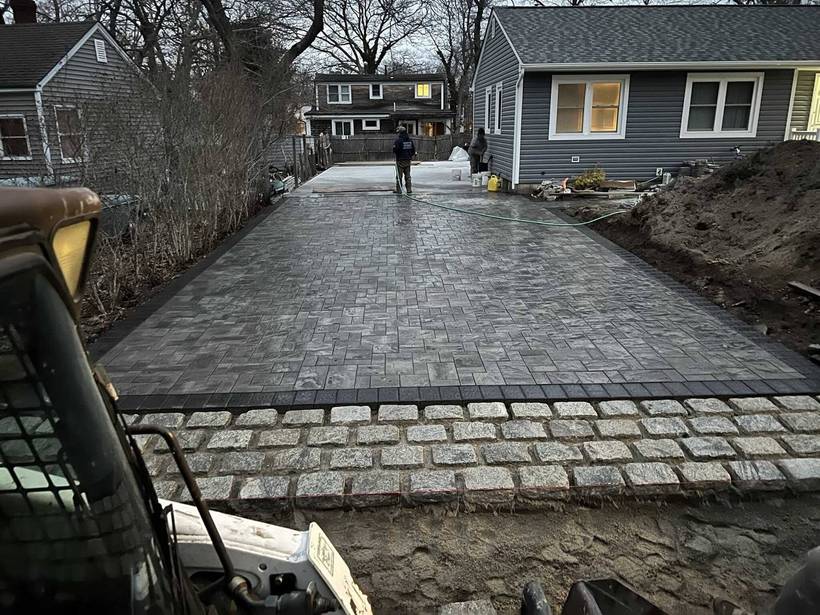
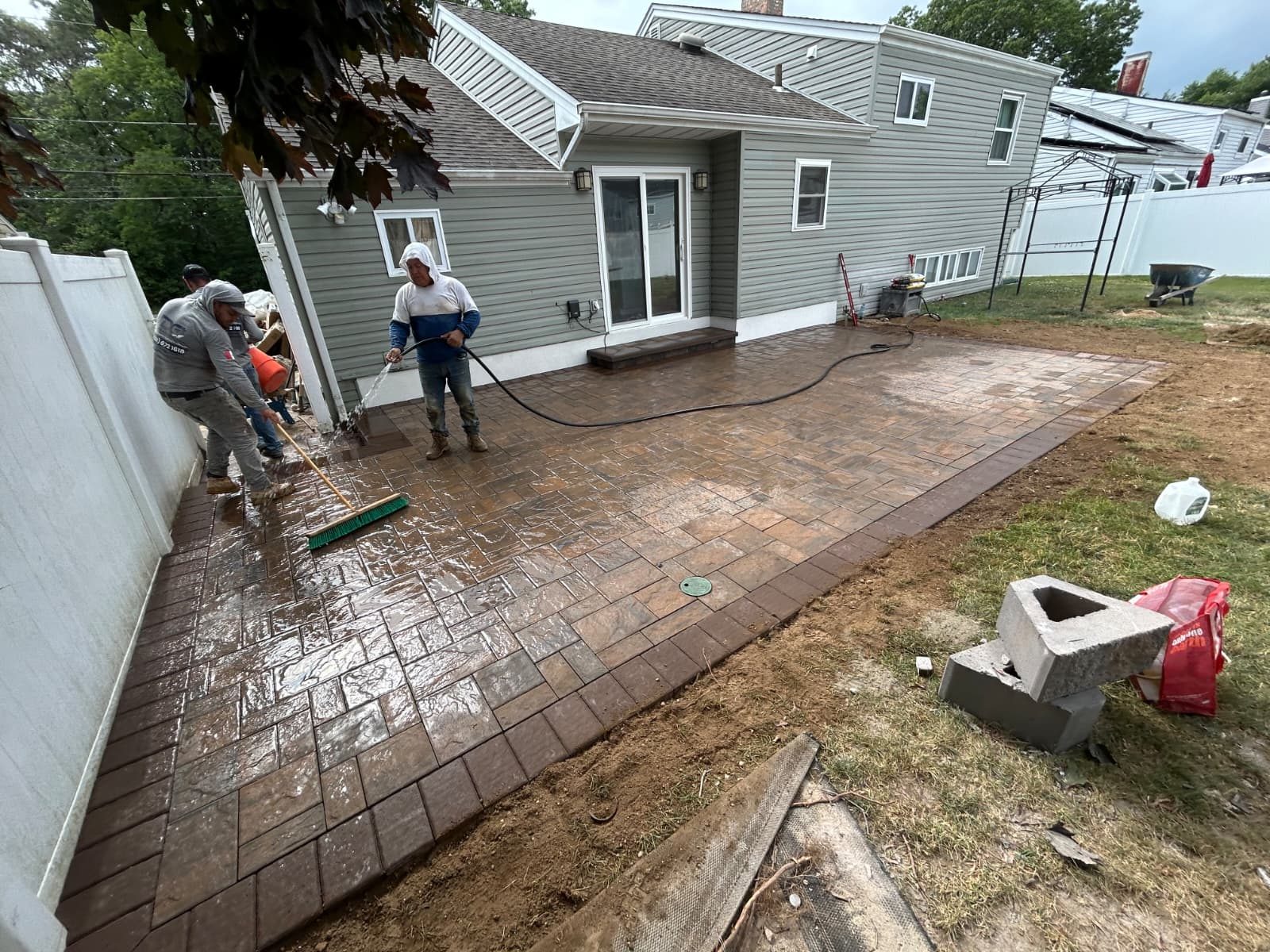
A paver patio is many individual units set on a screeded bedding layer over the compacted base. An edge restraint holds the outside course in place, the joints are filled with sand or polymeric sand, and the whole surface is compacted so the units lock together. Our paver patios page walks through the materials we use most in Suffolk County.
The result is a flexible surface. Each unit can move a hair without affecting its neighbors, and any single unit can be removed.
Look and pattern options
Stamped concrete can imitate almost anything, including large flagstone shapes and random ashlar patterns that would be expensive to do in real stone. Color is layered, so you get a base tone with a darker accent in the texture. The pattern is continuous across the slab, and you can add contrasting borders or bands.
Pavers come in set shapes and sizes, and the look depends on how they are laid. Running bond, herringbone, random ashlar and large-format slabs are all common on Long Island patios. Colors are baked into the unit, so they are consistent and do not depend on a sealer to stay vivid. Pavers also handle curves and inlays well, and you can mix borders and field units.
A rough way to think about it: stamped concrete gives you a convincing stone look with no joints, while pavers give you a real unit look with crisp lines. Both can look great in a Farmingville backyard. The difference is more about behavior than appearance.
Freeze-thaw, plows and salt on Long Island
Suffolk winters swing above and below freezing many times a season, and that cycle is what tests a patio.
Stamped concrete handles freeze-thaw well when it is air-entrained, properly jointed and sealed. The risk is water sitting in the texture and freezing, which can lift the surface in small flakes. Deicing salt makes that worse, especially in the first winter. We tell homeowners to use sand for traction and skip the salt on a new slab. Our post on new concrete and its first winter covers the same care for driveways.
Pavers shrug off salt better because the units are dense and the joints give the system room to move. The tradeoff is that joint sand can wash or get pushed out by a snow blower, and a plow blade can catch a unit that has lifted. Most backyard patios are shoveled rather than plowed, so this matters less than it does on a driveway.
Sealing and maintenance
Stamped concrete needs a sealer to protect the color and keep the texture from holding water. Expect to clean and reseal it on a regular schedule, and expect the color to soften if you skip it. Sealer can also get slick when wet, so we add a grit additive on steps and pool-side areas.
Pavers do not require sealing, but sealing helps lock the joint sand, resist stains and bring out the color. Joint sand needs topping off every so often, and weeds in the joints are the main complaint when that is skipped. Polymeric sand reduces that but is not maintenance-free.
Neither patio is zero maintenance. Stamped concrete asks for sealer, pavers ask for joint care.
Repairs: this is where they really differ
When a paver patio settles in one spot, we lift the units, rebuild the base in that area and relay the same pavers. If one cracks or stains, we swap it. Done right, nobody can tell.
When a stamped slab settles or cracks outside the control joints, options are more limited. Crack repair is visible. Replacing a section means a cold joint and a color match that is difficult because the original color weathered and the stamp mats have to line up. Small patches almost never disappear. This is the biggest reason some homeowners choose pavers next to a house where a utility line or a future waterproofing job might mean opening the ground.
Drainage and pitch next to the house
This part is the same for both and it is not optional. The patio must slope away from the foundation so rain and snowmelt run toward the yard, not toward the basement wall. Downspouts that land on the patio need to be extended under or past it. Where the patio meets the house, a stamped slab gets an expansion joint and pavers get a tight edge course, and in both cases the grade just beyond the patio has to keep falling away.
On a sloped yard, the patio may need a short retaining wall or steps to hold a level surface. That is a design question to settle before you pick a surface, and it is where good concrete work on footings and walls supports whichever patio goes on top.
Which one fits your yard
Here is how we usually frame it in Farmingville and the rest of the Town of Brookhaven.
Stamped concrete tends to fit a yard with stable soil, a simple rectangular or gently curved footprint, and a homeowner who likes a seamless stone look and is fine with resealing. It also fits where a continuous surface matters, such as a path that connects to an existing concrete walk.
Pavers tend to fit a yard with tree roots, past settling, utility lines near the patio or a lot of curves and inlays, and a homeowner who wants to be able to fix one spot without redoing the whole thing. They also fit anyone who prefers to skip sealer.
If you are torn, ask yourself what will bother you more in ten years: a sealer schedule or a joint sand schedule. That answer usually settles it. Permits for a patio depend on size, location and your lot, so check with the Town of Brookhaven before you commit to a footprint.
Ready to pick a surface?
JDG Concrete & Construction is based in Centereach, a short drive from Farmingville, and we hold Suffolk County Home Improvement License #HI-68303. We will look at your soil, your grade and your drainage and tell you straight which patio makes sense, even if it is not the one you walked in wanting. Call or text (631) 672-1618 or request a quote.
Frequently asked questions
Does stamped concrete crack on Long Island?
All concrete can crack, stamped or not, which is why control joints are cut or tooled into the slab so cracking happens along planned lines. A stamped patio built on a compacted base with proper joints and sealed regularly tends to hold up well through Suffolk winters. Random cracks usually trace back to a weak base, missing joints or water getting under the slab.
Do pavers shift or heave in a freeze-thaw climate?
Pavers move a little by design, because the joints give each unit room during freeze and thaw. Heaving or sinking usually points to a thin base, poor compaction or water pooling under one area. The upside is that a settled spot can be lifted, the base fixed and the same pavers relaid without a visible patch.
How often does a patio need to be sealed?
Stamped concrete generally wants a fresh coat of sealer every couple of years to protect the color and the surface, more often if it sees a lot of sun or foot traffic. Pavers do not have to be sealed, but sealing helps lock joint sand and resist stains. Either way, follow the product schedule rather than a fixed rule.
Which one is better for a patio right next to the house?
Both work next to a foundation as long as the surface is pitched away from the house and the base drains. Pavers give more flexibility if you ever need to open the area for a utility or waterproofing repair. Stamped concrete gives a continuous surface with fewer joints for water to find, as long as the pitch is right from day one.