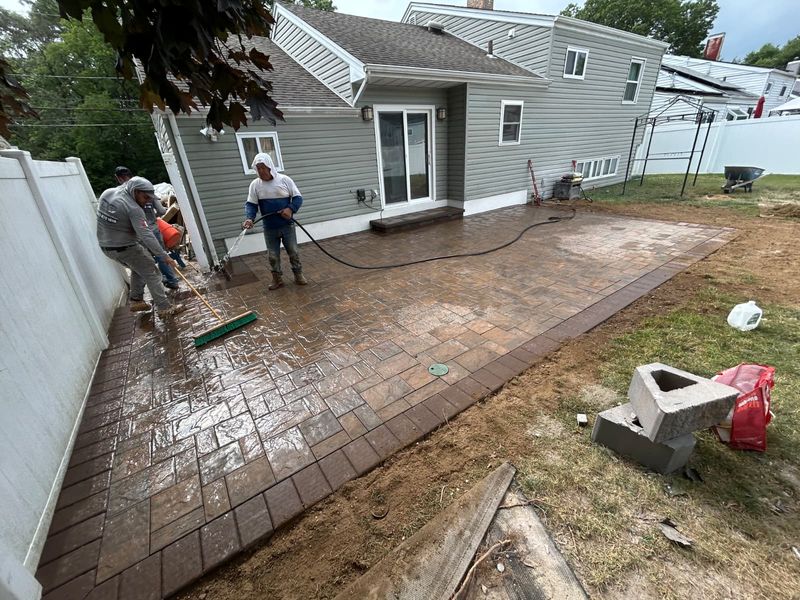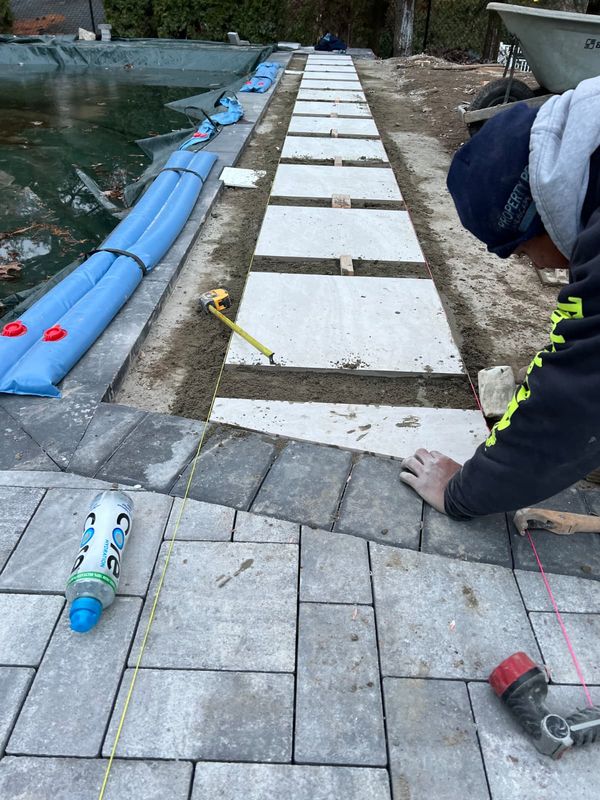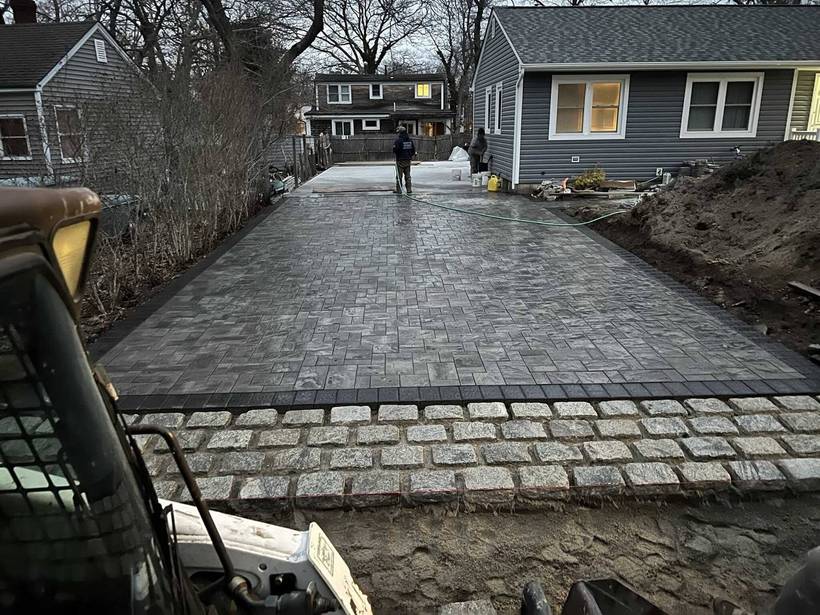
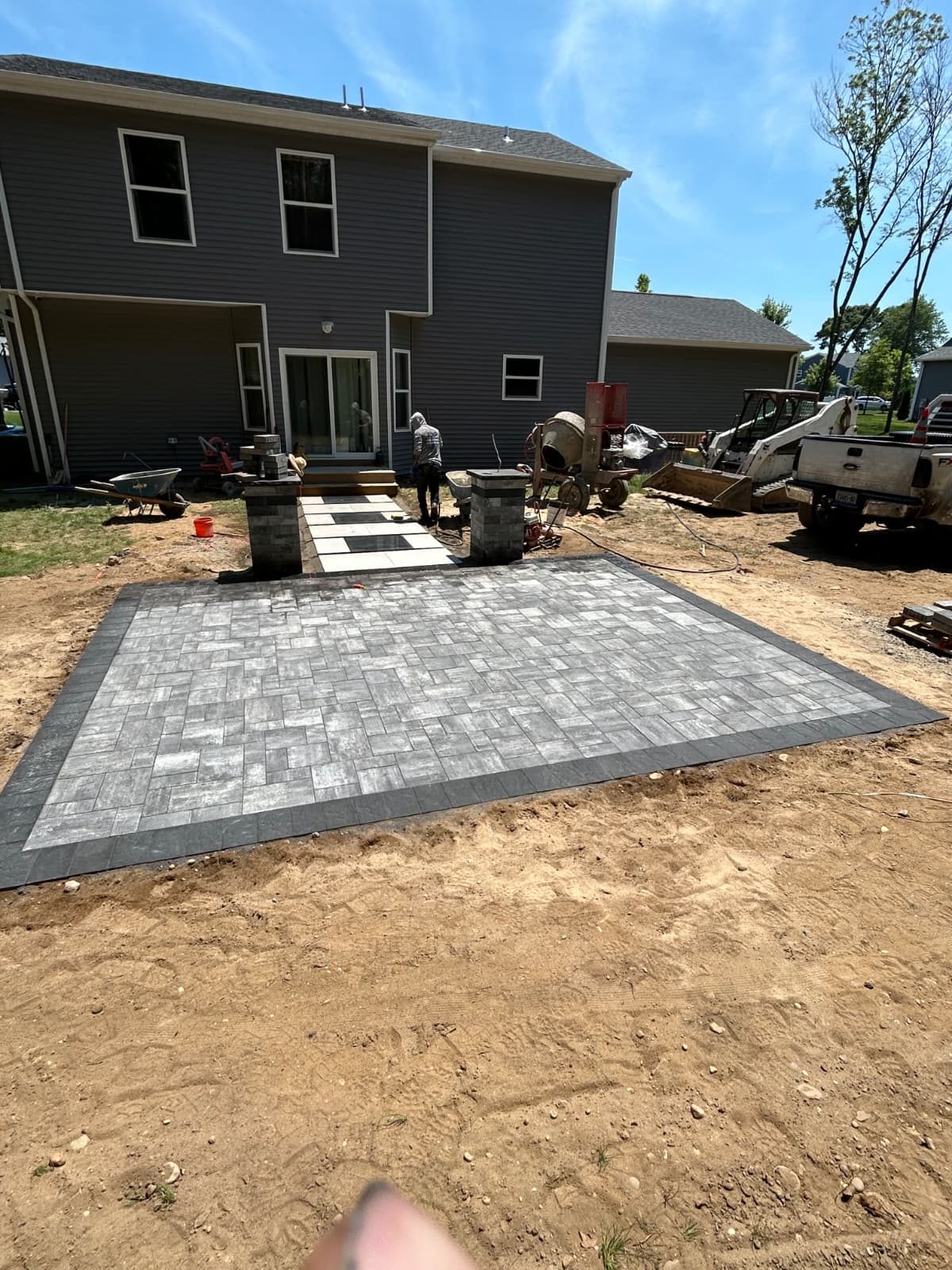
Walk out the back door of a Medford colonial onto a paver patio that is a few years old and you will often feel it before you see it: a dip right along the house, a lip at the sliding door threshold, maybe a row of pavers along the lawn edge that has rolled outward. The patio looked perfect the day it was finished. The ground under it had other plans.
This guide explains why paver patios sink where they do, how to tell settlement from frost heave, what a proper repair involves, and when a sinking patio is pointing at a drainage or foundation problem worth checking. It applies to paver patios built with new homes and especially to patios added right after additions, where the problem shows up most.
The backfill zone never stopped settling
When a foundation is built, the excavation is dug a few feet wider than the walls so crews can work. After the walls are up, that gap is filled back in. Ideally that backfill goes in in layers and each layer is compacted. In practice, on a lot of houses and most additions, it is pushed in with a machine and left for gravity to sort out.
Gravity takes years. Loose soil settles under its own weight, with every rain and every freeze-thaw cycle, until it is as dense as the undisturbed ground around it. A patio built on that strip before it is done settling goes down with it. That is why the dip is always along the house wall and nowhere else: the rest of the patio is sitting on ground that has not been touched in decades.
Downspouts and buried leaders
The second cause is water, and it also lives along the house. A downspout that discharges onto or next to the patio pushes roof water under the pavers at the same spot every storm. Bedding sand washes out, then base fines, and a void forms. The pavers above it drop.
Buried leaders can be worse because nobody sees them. A corrugated pipe that was run under the patio to a dry well or to daylight can crush, separate at a joint or clog with roots. The water then exits underground, right under the patio, and the base erodes from below. If a sunken zone lines up with a downspout, assume the pipe under it until proven otherwise.
Missing or shallow base
A paver patio is only as good as the compacted stone under it. A proper base is several inches of crushed stone placed in layers and compacted each time, on top of subgrade that has had the topsoil and organics removed. Over sandy Long Island soil that holds up well. Over a layer of topsoil, roots and construction debris that was never dug out, it does not.
Patios built on a thin base, or on a base that was spread and compacted once in a single thick layer, settle everywhere, not just at the house. The signs are a wavy surface, pavers rocking underfoot, and joints opening and closing across the whole field. That is a different problem from a backfill strip, and it leads to a different fix.
Edge restraint and the lawn side
The outside edges of a patio hold the whole field together. Edge restraint, a plastic or aluminum strip spiked into the base along the perimeter, keeps the pavers from spreading outward. When it is missing, spiked into sand instead of base, or has heaved out, the border row creeps toward the lawn, joints open up behind it, and pavers along the edge tip.
Joint sand, ants and washout
Polymeric sand in the joints hardens and locks the pavers together. It fails when it is installed on damp pavers, when it is not activated properly, or when water constantly runs across it. Once the joints are empty, the pavers can shift, water pours into the bedding layer, and ants move in and mine the sand out from below. Empty joints are not the cause of a sunken patio, but they are the open door that lets the base wash out faster.
Settlement or heave: tell them apart
A patio that is low along the house in all seasons has settled. A patio that is high in late winter and flattens out by June is heaving. Frost heave happens when water sits in the base or the subgrade and freezes. It points at drainage: a base that does not drain, clay under the patio, or a patio pitched so water runs toward the house and pools under it.
The fix for heave is water management, not just relaying pavers. The fix for settlement is rebuilding what dropped. Getting the diagnosis right first saves doing the job twice.
The repair: lift, rebuild, relay
When the base is sound under most of the patio and only a zone has dropped, the patio does not need to come out entirely. We mark the sunken area plus a margin, lift those pavers and stack them in order, and dig out the bedding sand and the top of the base.
Then the base gets rebuilt. If the drop was a backfill strip, we excavate until we hit material that will not move further, add compacted stone in thin lifts, and compact each lift. If a void from a washed-out leader is the cause, the pipe is repaired or rerouted first so the void does not come back. Where the subgrade is questionable, a layer of geotextile fabric between soil and stone keeps the base from pumping down into it.
We re-screed the bedding sand, relay the same pavers in the same pattern, cut any that need it, reset the edge restraint on compacted base, and sweep in fresh polymeric sand on a dry day. The repaired zone should be invisible when it is done, and it should stay where it is.
When the whole patio has to be rebuilt
If the base was thin or never compacted, lifting one area and fixing it leaves you with a good square in the middle of a patio that is still moving. In that case the honest answer is a full rebuild: pull all the pavers, excavate to proper depth, build the base right, and relay. Most pavers can be reused if they are in good shape, which keeps the look and saves material.
Our post on paver driveway base depth goes deeper on what a base needs to carry weight. A patio does not carry cars, but the principle is the same: the base is the patio, the pavers are just the surface.
Pitch toward the house is the real danger
A patio is supposed to slope away from the foundation so rain runs toward the lawn or a drain. When the strip along the house settles, the pitch reverses. Now every storm sends water toward the wall, down the backfill zone, and against the foundation. In Medford homes with a finished basement, that shows up as a damp wall or a wet carpet along the patio side.
If you have a patio that has dropped along the house and a basement that has started getting damp on the same side, treat them as one problem. Fixing the pavers without checking what the water has been doing to the wall is only half the job.
Tie the downspouts into a pipe that leaves
Part of any repair along a house is getting roof water off the patio. We connect the downspouts to solid pipe, not corrugated, run it under the patio base on a steady pitch, and discharge it past the patio to a dry well, a drainage structure or daylight on your own property. Solid pipe does not crush or let roots in the way corrugated does, and a cleanout at the top lets you flush it.
Building it right after an addition
If a patio is going in next to a new addition, the order matters. Backfill should be compacted in lifts during construction. The patio base should be excavated deeper in the backfill zone and compacted in thin layers so it bridges the soft strip. Downspouts should be piped before the base goes down. And the patio should pitch away from the new wall with a margin, because some settlement is still coming. When JDG builds the addition and the patio, those steps happen in sequence because the same crew is responsible for both.
Patio dropping along the house?
JDG Concrete & Construction is based in Centereach, a short drive from Medford, and we hold Suffolk County Home Improvement License #HI-68303. We will probe the base, trace the downspouts, check the basement wall and tell you honestly whether this is a zone repair or a rebuild. Call or text (631) 672-1618 or request a quote.
Frequently asked questions
Why is my patio only sinking along the house?
The strip of soil next to a foundation is backfill that was dumped into the excavation when the house or addition was built. It keeps settling for years, and a patio built on it before it finished settling drops with it. Downspouts dumping at the foundation speed that up.
Can sunken pavers be lifted and relaid, or does the patio need to be rebuilt?
If the base under most of the patio is sound and only a zone has dropped, we lift that area, rebuild and compact the base, relay the same pavers and reset the edge. If the base was thin or never compacted, the whole patio keeps moving and a full rebuild is the honest answer.
Is a sinking patio a sign of a foundation problem?
Usually it is a base and water problem, not a structural one. But a patio pitched toward the house sends water at the foundation, and a sudden drop next to a wall can mean a washed-out void. We check the basement wall and the drainage before we decide the fix is just pavers.
How soon after an addition can a patio go in?
The backfill around a new foundation should be compacted in lifts during construction, not just pushed in. Even then, give it time and build the patio on a deep compacted base that bridges the backfill zone. Building a patio the week the addition is finished is asking for a sunken strip along the new wall.